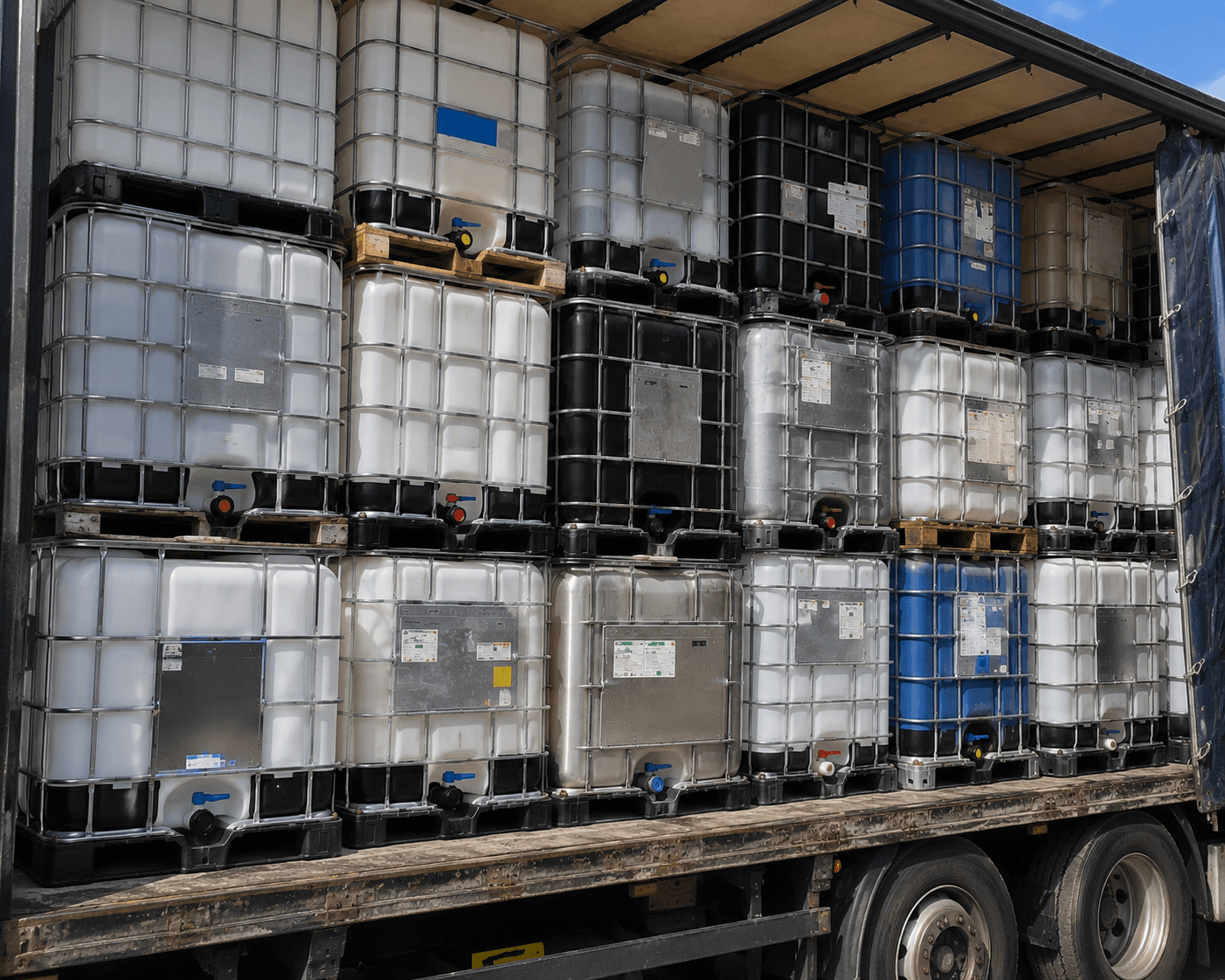
IBC Pickup & Delivery
Anywhere in the USA
From a single tote to a full truckload of 80 IBCs, we handle the logistics end to end. Dedicated fleet in the Midwest, nationwide carrier network everywhere else. You schedule it, we move it.
Request a Shipping Quote
Tell us the origin, destination, quantity, and timeline. We'll respond with FTL, LTL, and dedicated options within one business day.
Nationwide
Coverage across all 48 states
FTL & LTL
Full and partial loads
GPS Tracked
Real-time shipment visibility
Nationwide Coverage, Regional Expertise
We serve all 48 contiguous states from our Grand Rapids, MI hub. Transit times and service frequency vary by region — here is what to expect.
Midwest Hub (Same-Week)
Michigan, Ohio, Indiana, Illinois, Wisconsin, Minnesota, Iowa
Our home territory. Dedicated fleet trucks run daily routes. Same-week pickup is standard, and next-day service is available for most locations.
Northeast Corridor
New York, New Jersey, Pennsylvania, Connecticut, Massachusetts, Maryland, Virginia
High-density industrial corridor with frequent LTL and FTL lanes. Partner carriers provide competitive rates and reliable transit times.
Southeast
Georgia, Florida, North Carolina, South Carolina, Tennessee, Alabama, Mississippi
Growing coverage with weekly consolidated routes to Atlanta, Charlotte, and Jacksonville hubs. FTL service is available to any address.
South Central / Texas
Texas, Louisiana, Oklahoma, Arkansas, Missouri, Kansas
Major petrochemical and food-processing region. We maintain partner depot relationships in Houston, Dallas, and Kansas City for faster turnaround.
Mountain / West
Colorado, Utah, Arizona, New Mexico, Nevada, Montana, Wyoming, Idaho
Longer transit due to distance from our Grand Rapids hub. FTL rates are most competitive for this region. LTL shipments route through Denver and Salt Lake City.
Pacific Coast
California, Oregon, Washington
West Coast service via intermodal rail-truck or direct FTL. High-volume California lanes (LA, Central Valley, Bay Area) move weekly.
FTL, LTL, Dedicated & Expedited
We offer multiple transportation modes to match your volume, budget, and timeline. Every option includes load tracking and proof-of-delivery documentation.
Full Truckload (FTL)
The most cost-effective way to move large quantities. A standard 53-foot dry van holds 60-80 composite IBCs stacked four-high (4 per pallet footprint x 15-20 pallet positions). Flatbed trailers accommodate the same count with the advantage of crane or side-forklift loading at facilities without dock access.
Shipments of 60+ IBCs or when per-unit cost matters most.
Less-Than-Truckload (LTL)
For quantities below a full truckload, we consolidate your IBCs with other cargo on shared carriers. LTL shipments are palletized and shrink-wrapped to prevent shifting. Transit times are typically 3-7 business days depending on origin and destination within the continental US.
Shipments of 1-59 IBCs or when you need flexible scheduling.
Dedicated Fleet Pickup
Our own box trucks and flatbeds run scheduled routes throughout the Midwest corridor (MI, OH, IN, IL, WI, MN) and major metro areas nationwide. Dedicated pickups eliminate broker margins and give you a single point of contact from dispatch to delivery.
Recurring pickups, buyback program participants, and regional customers.
Hot-Shot / Expedited
When time is critical, our expedited service dispatches a dedicated vehicle within 24-48 hours. Hot-shot loads move on sprinter vans (1-4 IBCs), straight trucks (5-20 IBCs), or exclusive-use trailers for larger urgent orders.
Emergency needs, production-line shortages, or time-sensitive reconditioning jobs.
Stacking & Loading Specifications
Proper stacking maximizes trailer utilization and prevents damage in transit. Follow these specifications for safe, efficient IBC transport.
Per UN 31HA1 dynamic stacking test. Never exceed 4-high during transport.
Both wood and plastic IBC pallets fit the standard 48x40 footprint.
Includes cage, bottle, pallet, valve, and lid.
Water at 8.34 lbs/gal. Actual weight varies by product density.
Legal gross vehicle weight limits the load, not trailer volume for full IBCs.
Per FMCSA 49 CFR 393.100. Minimum 1 tiedown per 2 rows of stacked IBCs.
Flexible Scheduling. Full Visibility.
We work around your production schedule, not the other way around. Pickups can be scheduled for specific days and time windows, including early morning, evening, and weekend appointments for facilities with limited weekday dock availability.
Every shipment receives a unique tracking number linked to our logistics management system. You get automated email or SMS notifications at key milestones: dispatch, pickup confirmation, in-transit checkpoints, and proof-of-delivery with photographic documentation.
For recurring customers, we provide a dedicated logistics coordinator who manages your account, handles scheduling changes, resolves exceptions, and provides monthly reporting on shipping volumes, costs, and on-time performance metrics.
Cost-Saving Tips for Shipping IBCs
Freight is often the biggest variable cost in IBC management. These practical strategies can reduce your shipping spend by 20–50%.
Ship Full Truckloads Whenever Possible
The per-unit freight cost drops dramatically at FTL volumes. A full truckload of 80 empty IBCs might cost $2,500-$4,000 cross-country ($31-$50 per IBC), while shipping 10 units LTL on the same lane could run $80-$120 each.
Consolidate Pickups Across Facilities
If your company has multiple locations in the same metro area, scheduling one multi-stop pickup is far cheaper than dispatching separate trucks to each site.
Stack Four-High to Maximize Cube
Empty IBCs are cube-limited, not weight-limited. Stacking 4-high (the maximum safe transport height) doubles the number of totes per trailer versus 2-high loading.
Use Backhaul Opportunities
Trucks delivering new or reconditioned IBCs to your area often return empty. Ask about backhaul rates for your buyback or recycling shipments — they can be 30-50% below standard lane pricing.
Set Up Recurring Scheduled Routes
Recurring pickups on a set schedule (weekly, biweekly, monthly) qualify for contracted rates that are 15-25% below spot-market pricing. Volume commitments lock in stable costs.
Prepare IBCs for Efficient Loading
Stage your IBCs on a flat, forklift-accessible surface near your loading dock. Pre-stacked pallets and clear access reduce driver dwell time, which keeps accessorial charges off your invoice.
Tracking & Shipping Documentation
Bill of Lading (BOL)
Standard VICS BOL issued for every shipment, documenting origin, destination, piece count, weight, and commodity description. Required for freight claims.
Proof of Delivery (POD)
Signed delivery receipt with date, time, piece count verification, and photographic confirmation. Emailed to you within hours of delivery completion.
Shipment Tracking
Real-time GPS tracking for dedicated fleet loads. Carrier-provided milestone tracking for LTL and FTL partner shipments. Automated status notifications via email or SMS.
Freight Invoice
Itemized invoice showing base freight, fuel surcharge, and any accessorials (liftgate, lumper, detention). No hidden fees — what we quote is what you pay.
Packing List
Detailed packing list with IBC serial numbers (when applicable), condition grade, pallet count, and stack configuration for inventory reconciliation at destination.
Insurance Certificate
All shipments are covered under our freight liability insurance. Certificates of insurance are available upon request for high-value or specialized loads.
Transportation & Logistics Questions
How many IBC totes fit on a truck?
Do you ship to all 50 states?
What is the difference between FTL and LTL shipping?
How high can IBC totes be safely stacked for transport?
Can I track my IBC shipment?
Let Us Handle the Logistics
Whether you are shipping 1 IBC or 1,000, we have the fleet, the carrier network, and the expertise to move your containers safely and on time.