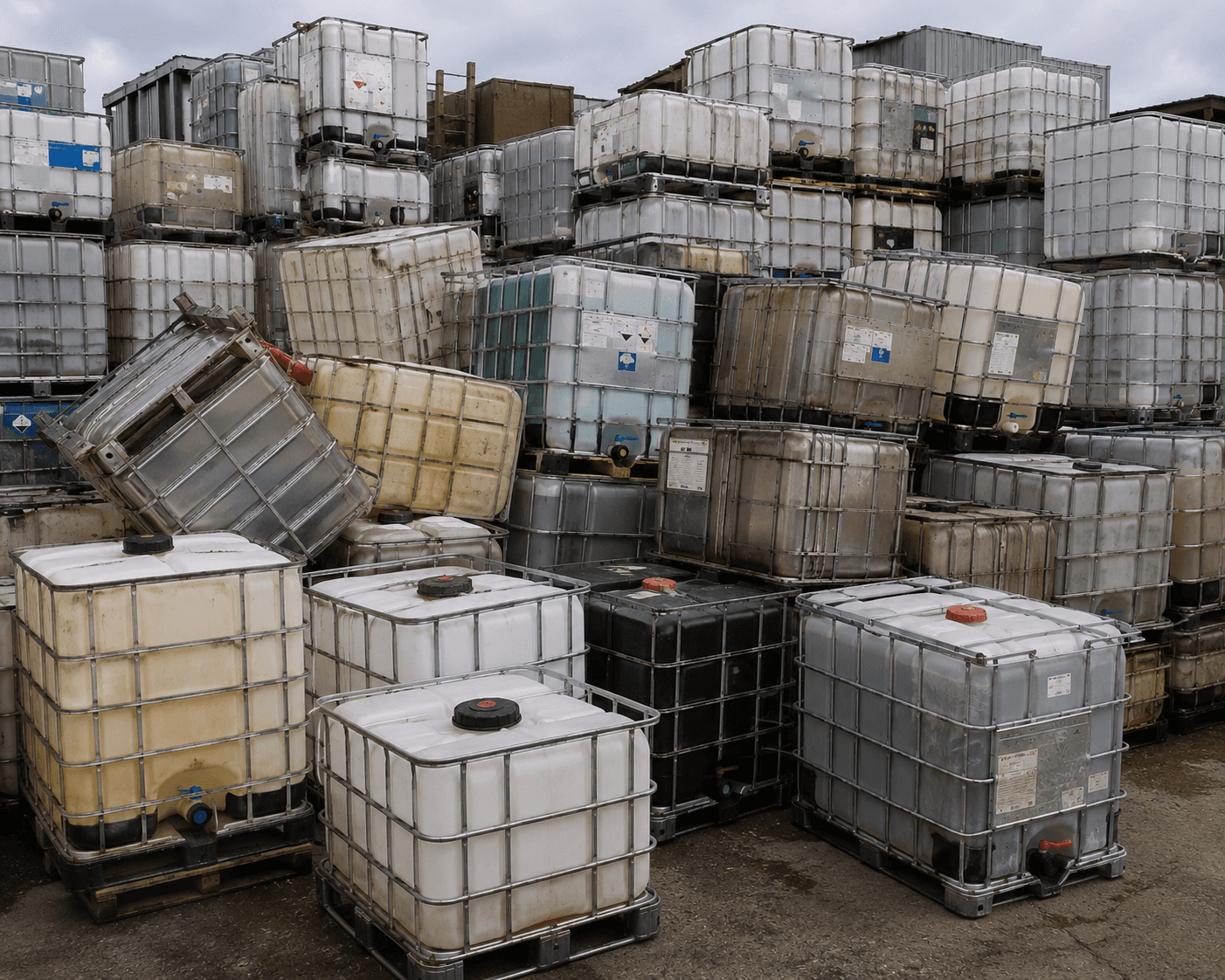
IBC Recycling With a
Zero-Landfill Guarantee
When an IBC reaches the end of its usable life, responsible recycling is the only acceptable path. We disassemble every container down to its raw materials and return them to the supply chain — nothing goes to landfill.
Request Recycling Service
Tell us about your end-of-life IBCs. We'll confirm whether they qualify for buyback or should enter the recycling stream — and arrange pickup either way.
Every Component Gets Recycled
HDPE bottles are shredded and pelletized. Steel cages are smelted into new metal. Wood pallets are chipped for mulch or biomass. Nothing goes to landfill.
When Recycling Is the Right Choice
Not every IBC can be reconditioned for reuse. Here are the common scenarios where recycling is the responsible and cost-effective path.
Expired UN Rating
Composite IBCs carry a 5-year service life from date of manufacture. Once expired, they cannot legally transport UN-regulated goods and should be recycled rather than stored indefinitely.
Structural Cage Damage
Bent corner posts, fractured welds, or collapsed top rails compromise stacking integrity. A damaged cage cannot be safely reused and is best recovered as scrap steel.
Cracked or Brittle HDPE Bottle
UV degradation, impact cracks, or chemical stress cracking make the bottle unsuitable for reconditioning. The HDPE is still valuable as recycled resin feedstock.
Persistent Contamination
Some chemicals permanently stain or permeate the HDPE wall — inks, dyes, strong solvents, or certain pesticides. These bottles cannot be cleaned to acceptable standards for reuse.
Regulatory Decommissioning
Certain industries (pharmaceuticals, pesticides) require certified destruction of containers. Our documented recycling process satisfies chain-of-custody destruction requirements.
Surplus Inventory Reduction
If you have more empties than the resale market can absorb, recycling clears yard space immediately while still recovering material value and generating compliance documentation.
How We Recycle an IBC Tote
A six-stage industrial process that separates every IBC into its constituent materials and feeds each one back into the manufacturing supply chain.
Intake & Assessment
Every incoming IBC is weighed, photographed, and assessed. We record the container type, previous contents, condition grade, and UN rating status to determine the optimal processing path.
Draining & Residue Removal
Remaining product residue is drained and collected for proper disposal or reclamation. Containers are triple-rinsed with heated water or solvent, depending on the prior contents, to eliminate chemical traces.
Disassembly & Separation
The HDPE bottle is separated from the galvanized steel cage. Valves, gaskets, and fittings are removed. Pallets (wood or plastic) are diverted to their respective recycling streams.
HDPE Grinding & Pelletizing
Bottles are shredded into flake, washed in a hot-caustic float-sink tank to remove labels and adhesive, then extruded into recycled HDPE pellets. These pellets become drainage pipe, plastic lumber, and new containers.
Steel Baling & Smelting
Cages are flattened in a hydraulic baler and shipped to regional steel mills. Galvanized steel is arc-furnace smelted and returns to the supply chain as structural steel, rebar, or new cage material.
Documentation & Certification
A Certificate of Recycling is generated for every lot. It includes weights, material disposition, recycling facility details, and chain-of-custody documentation for your environmental compliance records.
Where Every Material Goes
A composite IBC is made of multiple materials. We achieve near-total recovery across every component, keeping cumulative landfill diversion above 97%.
HDPE (Bottle)
98%+ RecoveryGround into flake, pelletized, and sold to manufacturers of pipe, lumber, automotive parts, and new containers.
Galvanized Steel (Cage)
99%+ RecoveryBaled and smelted at EAF steel mills. Returns as structural steel, rebar, appliances, or new IBC cages.
Wood Pallets
95%+ RecoveryIntact pallets are repaired and resold. Damaged pallets are chipped for mulch, biomass fuel, or animal bedding.
Plastic Pallets
99%+ RecoveryGround and re-molded into new pallets or other rotational-molded products.
Valves & Fittings
90%+ RecoveryPolypropylene and brass components are sorted and sent to their respective recycling streams.
Labels & Adhesives
85%+ RecoveryRemoved during the hot-wash process and filtered from wash water. Paper labels go to fiber recovery.
Regulatory Compliance & Environmental Standards
IBC recycling is not a casual scrap operation. We operate under strict federal and state environmental permits and follow documented procedures at every stage.
EPA RCRA Compliance
All IBC recycling operations follow Resource Conservation and Recovery Act (RCRA) guidelines for the management of containers that held hazardous and non-hazardous materials. Containers are classified under 40 CFR 261.7 as "empty" once properly triple-rinsed.
DOT Decommissioning
UN-rated IBCs past their 5-year service life or 2.5-year retest period are permanently marked as decommissioned per DOT 49 CFR 178.801 before material recycling, ensuring they cannot re-enter regulated transport service.
State Environmental Permits
Our processing facility operates under valid Michigan DEQ (EGLE) solid waste processing permits and wastewater discharge permits. We maintain current permits in every state where we operate satellite collection points.
OSHA Safety Standards
All dismantling and shredding operations comply with OSHA 29 CFR 1910 standards for general industry, including confined-space entry for large-scale tank cleaning, PPE requirements, and lockout/tagout procedures.
Our Zero-Landfill Commitment
Every IBC that enters our facility leaves as reusable product or recovered raw material. This is not a marketing aspiration — it is an audited, documented operational reality. Our annual waste audit, conducted by an independent third party, consistently shows landfill diversion rates above 97%.
The remaining fraction (under 3%) consists of non-recyclable adhesive residues and contaminated wash water solids, which are processed through licensed waste-to-energy facilities rather than landfilled. This means true zero-landfill across the entire IBC recycling stream.
For every 1,000 IBCs we recycle, we prevent approximately 60 tons of HDPE plastic and 32 tons of steel from entering landfills. That material re-enters the economy as pipe, lumber, rebar, and new containers — a genuine circular model.
Certificates & Compliance Records
Proper documentation is as important as the recycling itself. Every client receives a complete paper trail for regulatory and sustainability reporting.
Certificate of Recycling
Issued per lot, documenting the quantity of IBCs processed, date of recycling, and material disposition breakdown (HDPE weight, steel weight, other materials).
Certificate of Destruction
For regulated industries requiring documented container destruction. Includes serial numbers, photographs, and chain-of-custody from pickup to final processing.
Weight Tickets
Certified scale tickets for every inbound load, providing auditable proof of the tonnage diverted from landfill for your sustainability metrics.
Waste Profile Sheets
Pre-recycling waste characterization documentation required for containers that held hazardous materials, ensuring RCRA-compliant processing.
Annual Sustainability Summary
For recurring clients, an annual roll-up report quantifying total IBCs recycled, materials recovered, carbon offset, and landfill diversion for ESG reporting.
Downstream Vendor Audits
Copies of our downstream recycler audits and permits, verifying that HDPE resin and steel scrap reach legitimate end markets rather than being exported or dumped.
IBC Recycling Questions
Do I have to pay to recycle my IBC totes?
Can you recycle IBCs that held hazardous chemicals?
What documentation do I receive after recycling?
How much of each IBC is actually recycled?
Should I recycle or sell my used IBCs?
Recycle Responsibly. Document Everything.
Whether you have a dozen end-of-life IBCs or a thousand, we provide the same level of environmental compliance, material recovery, and documentation.