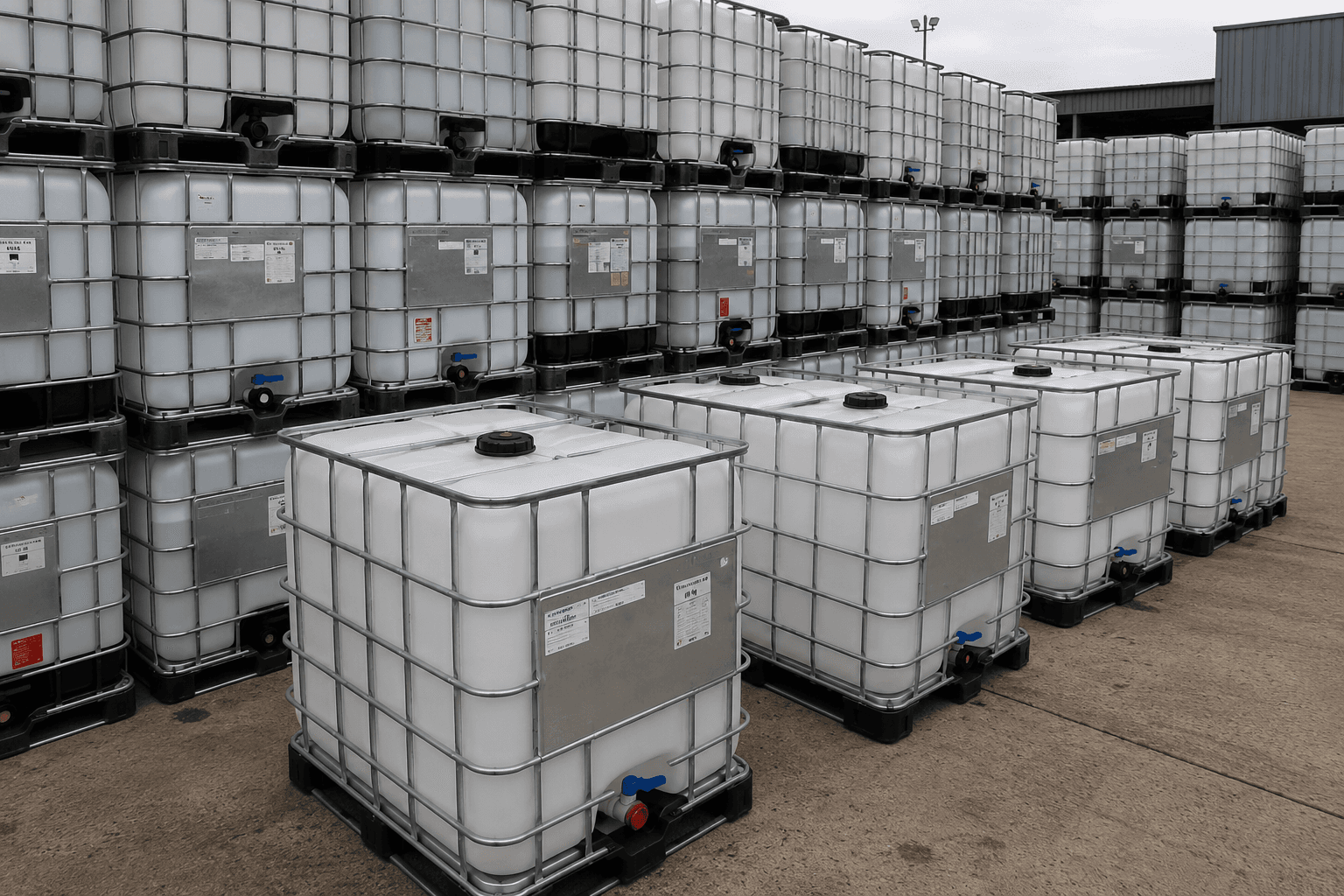
Our Sustainability Mission
Sustainability is not a marketing slogan for us — it is our entire business model. Every IBC tote we recondition eliminates the need for a new one to be manufactured, saving energy, water, raw materials, and carbon emissions at every step.
Go Green With Us
Ready to reduce your environmental footprint through smarter IBC management? Tell us what you need and we will build a sustainable solution.
The IBC Waste Crisis
A standard 275-gallon IBC tote weighs approximately 130 pounds and is constructed from high-density polyethylene (HDPE) with a galvanized steel cage. Manufacturing a single new IBC requires roughly 60 kg of virgin HDPE resin, 20 kg of steel, and significant energy input — equivalent to approximately 200 kg of CO2 emissions.
Despite being engineered for a multi-year lifespan and multiple reuse cycles, the majority of IBC totes in the US are used once and discarded. The result: an estimated 1.5 million containers per year entering the waste stream, representing over 90,000 metric tons of HDPE and 30,000 metric tons of steel that could be reclaimed.
Unlike simple plastic bottles, IBC totes are not accepted by curbside recycling programs. Their size, residual contents, and composite construction (plastic + metal) make them a specialized waste stream that requires dedicated infrastructure to handle properly.
Environmental Cost of One New IBC
Reconditioning an existing IBC uses less than 15% of these resources.
The Circular Economy Model
We keep IBC totes in productive use for as long as possible, then recover 100% of their material value. Here is how the cycle works.
Collection
We pick up used IBC totes from manufacturers, farms, chemical distributors, and food processors. Our buyback program pays fair market value for clean empties.
Inspection & Grading
Every tote is inspected for cage integrity, bottle clarity, valve function, and residual content. We assign Grade A, B, or C — or flag for material recycling.
Reconditioning
Reusable IBCs are triple-rinsed with biodegradable detergents, pressure-tested at 1.5x rated capacity, and fitted with new valves or bottles as needed.
Reuse or Recycle
Reconditioned totes return to market. End-of-life IBCs are disassembled: HDPE is shredded and pelletized, steel cages are baled for smelting. 100% material recovery.
Our Environmental Footprint Reduction
How IBC Reuse Cuts Carbon Emissions
The single biggest environmental win in IBC management is avoiding new manufacturing. Here is the carbon math on a per-container basis.
New IBC Manufacturing
Reconditioned IBC
Full Material Recycling
Certifications & Environmental Commitments
Our sustainability claims are backed by certifications, audits, and verifiable data. We maintain compliance with every relevant federal and state regulation.
Zero-Landfill Operations
Every IBC entering our facility exits as either a reconditioned container, recycled HDPE pellets, or recovered steel. Our waste stream audit confirms 100% diversion from landfill since 2021.
FDA-Compliant Reconditioning
Our wash processes meet FDA 21 CFR standards for food-contact containers. We use EPA-approved, biodegradable detergents and maintain full traceability from intake to dispatch.
DOT & UN Compliance
All reconditioned IBC totes are tested and certified under UN 31HA1 performance standards. We maintain compliance with DOT 49 CFR for the transport of hazardous and non-hazardous materials.
EPA Waste Management Standards
Our recycling processes comply with RCRA requirements. We provide certificates of recycling and chain-of-custody documentation for every container we process.
Closed-Loop Water System
Our wash facility reclaims and filters 90% of rinse water through a multi-stage treatment system. Residual wastewater is treated to meet local discharge standards before release.
Responsible Chemical Handling
Residual contents from used IBCs are captured, categorized, and disposed of through licensed hazardous and non-hazardous waste processors. Nothing goes down the drain.
Our Sustainability Roadmap
We are constantly pushing to reduce our own environmental footprint while expanding the positive impact of IBC reuse. Here is where we are headed.
Solar-Powered Facility
Install rooftop solar panels to offset 60% of our facility energy consumption, reducing grid dependence for wash operations, lighting, and compressed air systems.
100,000 IBCs Processed Annually
Double our reconditioning throughput with a second automated wash line and expanded storage capacity to keep more containers in circulation.
Electric Fleet Transition
Begin transitioning our local pickup and delivery trucks to electric vehicles, starting with last-mile operations in the greater Grand Rapids metro area.
Regional Satellite Facilities
Open collection and reconditioning hubs in the Southeast and Southwest to reduce transportation distances and associated emissions for clients in those regions.
Carbon Neutral Operations
Achieve net-zero carbon emissions across our entire operation including transportation, reconditioning, and administration through a combination of direct reduction and verified offsets.
Why IBC Recycling Matters Beyond Our Business
Intermediate Bulk Containers sit at the intersection of several critical environmental challenges. They are made from petroleum-derived HDPE, one of the most energy-intensive plastics to produce. Their steel cages require iron ore mining, coal-fired smelting, and galvanization. And their sheer volume — each one occupying roughly 48 cubic feet — means landfill space consumption is disproportionately large relative to their weight.
When we recondition an IBC tote and send it back into service, we are not just saving one container from the waste stream. We are avoiding the entire upstream supply chain that would have been activated to produce its replacement: the petroleum extraction, the polymerization, the extrusion and blow-molding, the steel production, the assembly, and the transportation of a brand-new unit from factory to end user.
The IBC industry in the United States is worth over $3 billion annually. If even half of the containers currently being discarded after single use were instead reconditioned and reused, the savings would amount to approximately 75,000 metric tons of CO2 per year — the equivalent of taking 16,000 cars off the road. That is the scale of impact that better IBC management can deliver, and it is why we come to work every day.
Water Conservation
Manufacturing a single new 275-gallon IBC tote from virgin materials consumes approximately 500 liters of water. That water is used across multiple stages: cooling during HDPE resin polymerization, quenching in the blow-molding process, surface treatment of the galvanized steel cage, and quality testing of the finished assembly. Most of this water becomes contaminated with process chemicals and requires treatment before it can be discharged.
Reconditioning an existing IBC at our facility uses approximately 60 liters of water per container — an 88% reduction compared to new manufacturing. This dramatic savings is possible because we are cleaning a finished product rather than manufacturing one from raw materials. Our triple-rinse process is efficient by design: the first rinse removes bulk residual contents, the second applies biodegradable detergent at calibrated temperature and concentration, and the third delivers a final sanitizing rinse that meets FDA standards for food-contact containers.
But the savings do not stop at the wash bay. Our closed-loop water reclamation system captures 90% of the water used in our cleaning operations. This water passes through a multi-stage treatment process including sediment filtration, oil-water separation, activated carbon adsorption, and UV disinfection before being recycled back into the wash system. Only 10% of our water input is discharged, and that discharge is treated to meet or exceed local water quality standards set by the City of Grand Rapids.
The cumulative effect is significant. In 2024 alone, by reconditioning IBCs instead of allowing them to be replaced by new containers, our operations contributed to saving an estimated 2.1 million gallons of water that would have been consumed in new manufacturing processes. Our water reclamation system saved an additional 400,000 gallons by recycling wash water internally rather than drawing fresh supply for every rinse cycle.
Water Usage Comparison Per IBC
Our closed-loop system reclaims 90% of wash water for reuse.
By reconditioning IBCs instead of replacing them with new containers, and by reclaiming wash water through our filtration system, we prevent millions of gallons of freshwater consumption every year.
Waste Stream Analysis
Every IBC tote is a composite product made from multiple materials. Our zero-landfill commitment means we have developed specific recovery processes for each component. Here is a detailed breakdown of what happens to every part of every container we process.
HDPE Bottle (Inner Container)
The high-density polyethylene bottle is the primary liquid-holding component. When reusable, it is cleaned and returned to service. End-of-life bottles are removed from the cage, shredded into flake material approximately 10-15mm in size, washed to remove residual contamination, and dried in a centrifugal system. The clean HDPE flake is then either sold to pelletizing facilities that convert it into recycled resin for new plastic products, or processed directly into pellets at our facility. Recycled HDPE from IBCs is commonly used to manufacture drainage pipes, plastic lumber, non-food containers, and automotive components.
Galvanized Steel Cage
The steel cage provides structural support and stackability. Cages in good condition are reused with new bottles (rebottling). Damaged or corroded cages are separated from the IBC assembly using hydraulic shears and angle grinders. The steel is then compacted into dense bales using our horizontal baling press and shipped to regional steel smelters for melting and reprocessing. Galvanized steel from IBC cages is readily accepted by scrap metal processors because it has a consistent composition and is free of major contaminants. The recovered steel typically reenters the supply chain as rebar, structural steel, or new cage material.
Composite Pallet (Base)
IBC pallets are typically made from HDPE, wood, or galvanized steel depending on the manufacturer. Plastic pallets in good structural condition are cleaned and reused. Damaged HDPE pallets are shredded and recycled along with bottle material. Wooden pallets are inspected for reuse or sent to licensed wood recycling facilities that chip them for landscape mulch, biomass fuel, or particle board manufacturing. Steel pallets follow the same smelting path as cage material. We track pallet type and condition as part of our intake inspection.
Valve Assembly
IBC valves are typically made from polypropylene (PP) or HDPE with EPDM rubber gaskets and sometimes stainless steel components. During reconditioning, valves are the most commonly replaced part. Worn valves are disassembled into their component materials: plastic bodies are recycled with other polymer streams, rubber gaskets are sent to rubber recycling processors, and any metal components are added to our steel bale. New butterfly or ball valves are installed on every reconditioned IBC to ensure leak-free performance.
Lid & Gasket Assembly
IBC lids are typically HDPE with an EPDM or Viton gasket seal. Lids in good condition with intact sealing surfaces are cleaned and reused. Damaged lids are shredded with other HDPE material. Gaskets that have lost elasticity or show chemical degradation are replaced during reconditioning. Spent gaskets are collected separately and sent to specialized rubber recycling facilities. We stock replacement lids and gaskets from multiple manufacturers to ensure compatibility across the wide range of IBC brands we process.
Residual Contents
Many IBCs arrive at our facility with residual liquid contents. These residuals are captured during the intake and draining process, categorized by chemical type, and stored in dedicated containment tanks. Non-hazardous residuals such as food-grade liquids, soaps, and water-soluble chemicals are treated through our wastewater system before discharge. Hazardous residuals are collected by licensed hazardous waste transporters and sent to permitted treatment, storage, and disposal facilities (TSDFs). We maintain detailed records of all residual handling for EPA and state DEQ compliance.
Every material stream from every IBC component has a defined recovery pathway. Nothing is landfilled. Our waste stream audits, conducted quarterly by our environmental compliance team, verify this 100% diversion rate with documented weight tracking from intake through final disposition.
Supply Chain Sustainability
Sustainability does not stop at the facility door. We have designed our entire logistics operation to minimize transport emissions and maximize the efficiency of every mile driven.
Backhaul Coordination
Every delivery route is an opportunity for a pickup. When our trucks deliver reconditioned IBCs to a customer, our logistics team coordinates pickups of used containers from nearby locations on the return leg. This backhaul strategy means our trucks rarely run empty, reducing the total miles driven per IBC moved by an estimated 35%. In 2024, our backhaul coordination eliminated approximately 120,000 empty miles from our transportation network, saving roughly 18,000 gallons of diesel fuel and preventing over 180 metric tons of CO2 emissions.
Load Optimization
IBC totes are bulky, and freight costs are a significant part of the total cost of container recycling. Our logistics team achieves 95%+ cube utilization on every trailer, fitting up to 56 standard 275-gallon IBCs per 53-foot load. We use specialized stacking configurations that maximize container count while preventing damage in transit. By moving more containers per trip, we reduce the per-unit carbon footprint of transportation and pass those savings along to our customers in the form of lower freight costs.
Regional Consolidation Points
For customers outside the Midwest, we use regional consolidation points to batch shipments rather than running individual partial loads over long distances. Used IBCs from multiple sellers in a region are collected at a consolidation facility, then shipped to Grand Rapids in full truckloads. This approach reduces the number of long-haul trips required and lowers the per-unit transportation emissions for customers located far from our primary facility. We currently operate consolidation arrangements in the Southeast, Texas, and the Northeast corridor.
Carrier Selection & Standards
We partner with carriers who demonstrate a commitment to fuel efficiency and emissions reduction. Our preferred carriers operate EPA SmartWay-certified fleets, use aerodynamic fairings and low-rolling-resistance tires, and maintain their engines to current emissions standards. We track the average fuel efficiency of our carrier partners and factor this data into our route planning to minimize the environmental impact of every shipment. As part of our 2027 roadmap, we are evaluating electric and CNG-powered carriers for our regional routes.
Local Sourcing Priority
Whenever possible, we prioritize sourcing used IBCs from locations closest to our facility or closest to the end customer. This local-first approach reduces long-haul transportation needs and supports regional circular economy loops. In the greater Grand Rapids metro area, we offer same-day pickup for quantities of 10 or more IBCs, using our own box trucks rather than third-party carriers. This direct control over local logistics gives us the lowest possible emissions profile for Midwest-based transactions.
Emissions Tracking & Reporting
We track Scope 1 (direct) and Scope 3 (transportation) emissions across our entire operation. Every shipment is logged with origin, destination, load count, and carrier, allowing us to calculate per-unit and per-mile emissions with precision. This data feeds into our annual sustainability report and is available to customers who need supply chain emissions data for their own ESG reporting. We are committed to reducing our total transportation emissions by 25% per IBC processed by 2028 through a combination of route optimization, backhaul expansion, and fleet modernization.
Sustainability Partnerships
No single company can solve the IBC waste problem alone. We actively participate in industry groups and environmental organizations that are working to build a more sustainable bulk container ecosystem.
Reusable Industrial Packaging Association (RIPA)
As a member of RIPA, we participate in industry working groups focused on developing best practices for IBC reconditioning, establishing standardized grading criteria, and advocating for policies that encourage container reuse over single-use disposal. RIPA membership connects us with other reconditioners, manufacturers, and end users who share our commitment to extending the useful life of industrial packaging. Through RIPA, we contribute to research on cleaning chemistry, container lifecycle analysis, and the development of reconditioning standards that the entire industry can adopt.
West Michigan Environmental Action Council
We are a corporate partner of the West Michigan Environmental Action Council (WMEAC), supporting their programs on waste reduction education, sustainable business practices, and community environmental advocacy. Our partnership includes sponsoring their annual sustainability conference, hosting facility tours for their members, and collaborating on educational content about the circular economy. WMEAC has been instrumental in connecting us with local schools and civic organizations that benefit from understanding how industrial recycling contributes to community environmental health.
Michigan Recycling Coalition
Through our membership in the Michigan Recycling Coalition, we engage with policymakers, waste management professionals, and other recyclers to strengthen recycling infrastructure across the state. We participate in their annual conference and contribute expertise on the specific challenges of recycling composite products like IBC totes. The Coalition provides a forum for sharing data on recycling rates, discussing policy proposals that affect the industry, and collaborating on public education campaigns that encourage businesses to recycle industrial packaging rather than landfill it.
EPA SmartWay Transport Partnership
We are a shipper partner in the EPA SmartWay Transport Partnership, committing to measure, benchmark, and improve the environmental performance of our freight operations. Through SmartWay, we track fuel consumption and emissions from our transportation network, select carriers who meet SmartWay efficiency standards, and report our logistics environmental performance annually. This partnership provides us with tools and data to continuously reduce the carbon intensity of our supply chain and gives our customers confidence that our logistics operations meet federal efficiency benchmarks.
Local Manufacturing Sustainability Consortiums
We participate in several West Michigan manufacturing sustainability groups, including the Grand Rapids Area Chamber of Commerce sustainability committee and informal consortiums of local manufacturers focused on waste reduction. Through these groups, we help other businesses understand the opportunity to recycle and reuse their IBC totes rather than disposing of them. We have developed tailored return-and-reuse programs for consortium members that reduce their waste management costs while feeding a steady supply of used containers into our reconditioning pipeline.
University Research Collaborations
We maintain ongoing relationships with researchers at Michigan State University and Grand Valley State University who study polymer degradation, recycling process efficiency, and circular economy models. These collaborations give us access to the latest findings on HDPE aging characteristics, optimal wash chemistry for different contamination types, and lifecycle assessment methodologies. In return, we provide researchers with real-world data from our operations and access to our facility for field studies. Several research projects have directly informed improvements to our wash processes and material recovery techniques.
Make Your IBC Supply Chain Greener
Every reconditioned IBC you buy saves ~170 kg of CO2. Every empty you sell to us stays out of the landfill. Start making a difference today.