Professional IBC
Cleaning & Reconditioning
Extend the productive life of your IBC fleet with industrial-grade cleaning, rebottling, and reconditioning services. From triple-wash to full rebottle, every tote leaves our facility pressure-tested and ready for service.
Get a Reconditioning Quote
Tell us about your IBCs — quantity, prior contents, and desired end use — and we'll recommend the right cleaning protocol and turnaround time.
Professional-Grade Facility
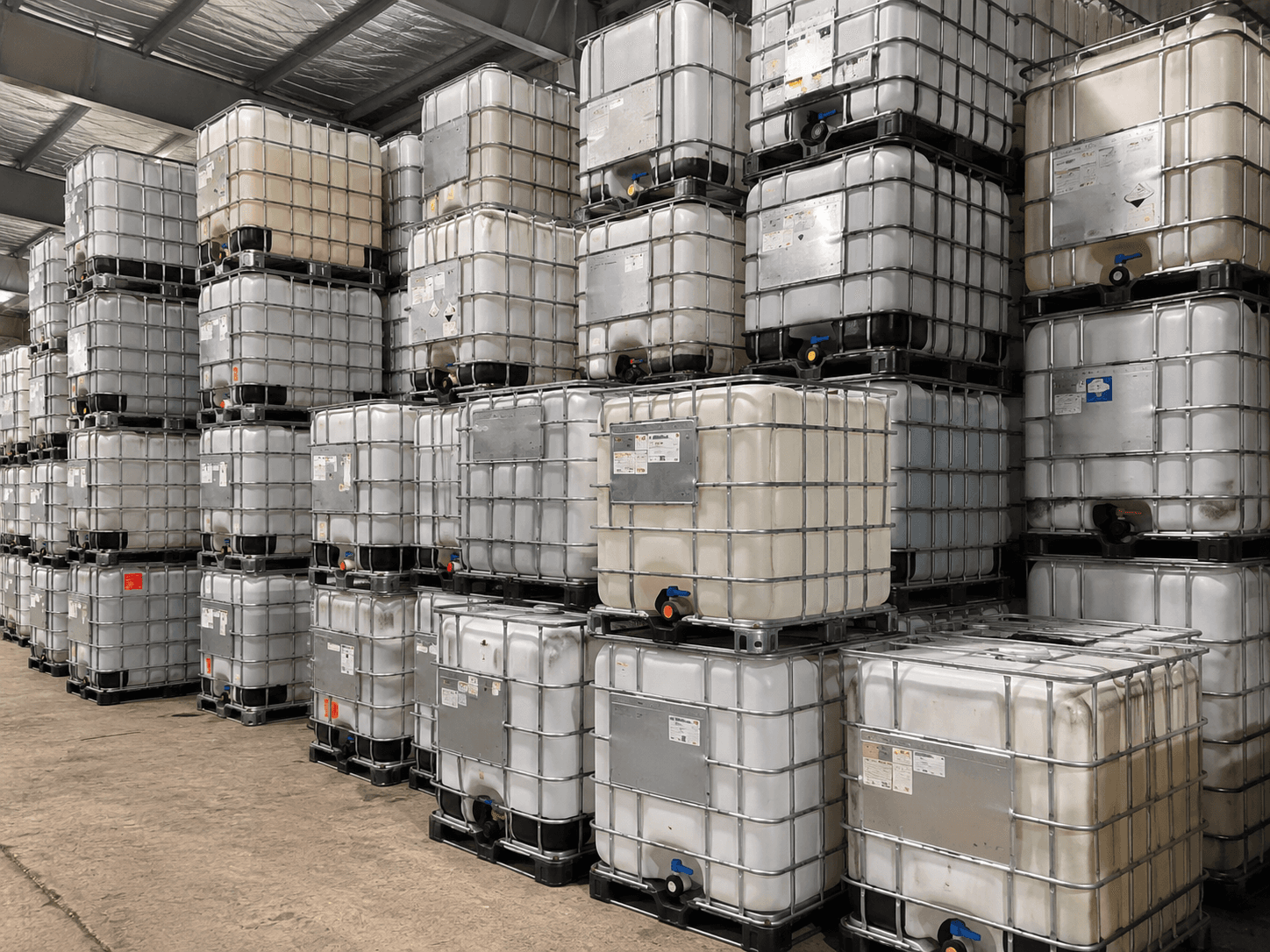
Our 15,000 sq ft cleaning and reconditioning facility in Grand Rapids processes hundreds of IBC totes per week with industrial-grade wash stations and pressure testing equipment.
Four Cleaning Protocols for Every Application
Different prior contents demand different cleaning approaches. We match the protocol to the chemistry for optimal results and the shortest turnaround.
Triple-Wash Cleaning
Our standard cleaning protocol involves three sequential wash cycles using heated water at 140-180 F with biodegradable surfactant. Each cycle includes fill, agitate, drain, and rinse stages. This process removes the vast majority of residual product from food-grade and light-chemical IBCs.
Food syrups, juices, soaps, detergents, glycerin, water-based chemicals
Steam Cleaning (Food-Grade)
For IBCs destined for food-grade reuse, we follow the triple-wash with a 212 F saturated-steam flush that sanitizes the interior surface. Steam penetrates micro-pores in the HDPE that liquid wash cannot reach, achieving bacterial reduction rates required for FDA-compliant food contact.
Edible oils, flavoring concentrates, beverage syrups, food-grade glycols
Chemical Decontamination
Totes that held aggressive chemicals require solvent-matched or caustic-wash decontamination. We use a rotating spray ball inserted through the top opening to deliver NaOH caustic solution, acid neutralizer, or compatible organic solvent at precise concentrations to break down residual films.
Industrial solvents, adhesives, latex, resins, agricultural chemicals
High-Pressure Rinse
A 3,000 PSI hot-water lance is used to blast stubborn residue from interior walls, especially in corners and around the bottom valve port where product tends to accumulate. This mechanical action supplements chemical cleaning for heavily soiled containers.
Paints, inks, dyes, viscous polymers, mineral slurries
The Full Reconditioning Process
Six stages from intake to shipment. Every step is documented and traceable back to the individual container.
Incoming Inspection
Every IBC is visually and structurally inspected upon arrival. We check the cage for bent rails, cracked welds, and missing hardware. The bottle is examined for UV yellowing, stress cracks, warping, and residue type.
Cleaning (Method Selection)
Based on the prior contents and intended next use, we assign the appropriate cleaning protocol: triple-wash, steam, chemical decontamination, or a combination. Cleaning parameters (temperature, chemistry, dwell time) are logged for traceability.
Rebottling (If Required)
If the existing HDPE bottle is damaged, stained, or incompatible with the next product, we remove it and install a brand-new virgin HDPE bottle. New bottles are UN-rated 31HA1 and restart the 5-year service clock.
Valve & Gasket Replacement
The 2-inch NPT bottom valve and 6-inch top lid gasket are replaced as standard practice on every reconditioned unit. We stock butterfly valves, ball valves, camlock adapters, and Banjo fittings to match your system.
Pressure Testing
Every reconditioned IBC undergoes hydrostatic pressure testing at 14.5 PSI (100 kPa) for 30 minutes per UN 31HA1 requirements. The test verifies weld seams, valve threads, lid gasket seal, and overall bottle integrity under load.
Final QC & Labeling
A final quality-control inspector verifies cleanliness (visual + residue swab), structural integrity, valve function, and pressure-test results. Approved units receive a new USA IBC Recycle condition label with grade, date, and tracking ID.
New Bottle, Proven Cage
Rebottling replaces the inner HDPE container while retaining the structurally sound steel cage. The result is a tote that performs identically to a brand-new IBC at roughly 40–60% of the cost. The new bottle is blow-molded from virgin high-density polyethylene resin, carries a fresh UN 31HA1 marking, and restarts the full 5-year regulatory service clock.
Before a new bottle is installed, the cage undergoes straightening, weld repair (if needed), rust treatment, and a fresh powder-coat or galvanized dip. Corner castings, fork pockets, and top fill ports are inspected for dimensional compliance. The pallet base — wood or plastic — is replaced if it shows signs of rot, warping, or impact damage.
Every rebottled IBC receives the same hydrostatic pressure test, residue swab, and valve torque check as a cleaned-only unit. The only difference is the bottle is brand new and the service life is fully reset.
Inspection Criteria & Pass/Fail Standards
Every reconditioned IBC must pass all eight inspection points before it ships. Containers that fail any criterion are either reworked or routed to recycling.
No yellowing beyond Pantone 7499 C reference swatch. UV-degraded bottles are replaced.
Minimum 2.5 mm at thinnest point measured with ultrasonic thickness gauge. Below threshold triggers rebottling.
Corner posts within 5 mm of true vertical. Leaning cages indicate structural fatigue and are rejected or straightened.
All cage welds visually inspected for cracks, porosity, and incomplete fusion. Failed welds are re-welded or cage is scrapped.
Interior swab test must show <50 ppm total organic residue for food-grade, <200 ppm for chemical-grade reconditioning.
No detectable odor upon opening lid after 24-hour sealed dwell period. Persistent odor fails the IBC to recycling stream.
2-inch NPT valve torqued to 35-45 ft-lbs with thread sealant. Leak-free at test pressure for 30 minutes.
New EPDM gasket, lid torqued to specification. Must hold 14.5 PSI without bubble formation in soapy-water leak test.
Cleaning Methods Deep Dive
Each cleaning method has distinct advantages and trade-offs. This detailed comparison helps you understand which protocol is right for your containers and intended reuse application.
Hot Water Wash (140-180 F)
Excellent for water-soluble residues
Advantages
- Lowest cost per unit — uses only heated water and biodegradable surfactant
- No chemical disposal concerns — wash water can be treated and discharged
- Fast cycle time allows high throughput (up to 80 IBCs per day)
- Safe for food-grade containers with no risk of chemical cross-contamination
- Gentle on HDPE — does not accelerate material degradation or stress cracking
Limitations
- Ineffective against oil-based residues, adhesives, and polymer films
- Cannot remove deeply embedded stains or odors from porous HDPE surfaces
- Requires multiple cycles for viscous products like corn syrup or molasses
- Water temperature must be carefully controlled to avoid HDPE warping above 185 F
Caustic Wash (NaOH Solution)
Superior for organic residues and protein-based films
Advantages
- Breaks down protein films, fats, and organic residues that water alone cannot remove
- Highly effective against dairy residues, meat by-products, and biological films
- Caustic solution can be recycled and reused across multiple wash cycles
- Proven sanitization properties — widely used in food and beverage CIP systems
- Effective at lower temperatures than hot water alone, reducing energy costs
Limitations
- Requires careful handling and PPE — NaOH is corrosive to skin and eyes
- Neutralization step needed before wastewater discharge adds cycle time
- Not compatible with aluminum fittings or certain gasket materials
- Prolonged exposure can cause micro-etching on HDPE surfaces over repeated cycles
Solvent Wash
Best for petroleum-based and polymer residues
Advantages
- Only method capable of dissolving cured adhesives, resin films, and polymer deposits
- Highly effective against petroleum-based products, mineral oils, and lubricants
- Can restore heavily contaminated containers to chemical-grade reuse standards
- Solvent selection is tailored to the specific prior contents for maximum efficiency
- Enables recovery of IBCs that would otherwise go straight to recycling
Limitations
- Highest cost per unit due to solvent procurement and disposal requirements
- Used solvents must be collected, manifested, and disposed as regulated waste
- Longer cycle time and extended ventilation requirements reduce daily throughput
- Not suitable for containers destined for food-grade reuse due to residual solvent risk
- Requires specialized ventilation and explosion-proof equipment in wash bay
Steam Cleaning (212 F Saturated Steam)
Gold standard for food-grade sanitization
Advantages
- Achieves the highest level of bacterial kill — 99.999% reduction in standard tests
- Penetrates micro-pores in HDPE that liquid wash cannot reach
- Leaves zero chemical residue — pure thermal sanitization
- Meets FDA requirements for food-contact surface sanitization
- Effective at removing volatile organic compounds and light odors
Limitations
- High energy consumption — generating saturated steam is resource-intensive
- Not a standalone method — must follow a primary wash cycle to remove bulk residue
- Thermal shock risk if HDPE is cold; containers must be pre-warmed to prevent cracking
- Limited effectiveness against heavy chemical contamination or staining
- Requires calibrated temperature monitoring to maintain 212 F throughout the cycle
14-Point Quality Control Checkpoints
Every reconditioned IBC passes through a rigorous 14-point inspection process. A single failure at any checkpoint routes the container to rework or recycling — no exceptions.
Exterior Cage Visual Inspection
All four corner posts, top rail, bottom rail, and cross-members checked for bends, cracks, broken welds, and missing hardware. Cage must be plumb within 5 mm.
Fork Pocket Integrity
Fork pockets inspected for bending, cracking, or separation from base frame. Must accept standard 6.5-inch fork tines without obstruction.
Pallet Base Condition
Wood pallets checked for rot, splitting, and nail protrusion. Plastic pallets checked for cracks and warping. Must support 5,500 lbs rated load.
Bottle Clarity & Color
HDPE bottle assessed against Pantone reference swatch. Yellowing beyond threshold triggers automatic rebottling. Clarity must allow visual inspection of contents.
Wall Thickness Measurement
Ultrasonic thickness gauge readings at four cardinal points plus bottom center. Minimum 2.5 mm at thinnest point. Below threshold triggers rebottling.
Stress Crack Detection
Interior and exterior surfaces inspected under high-intensity LED light for crazing, micro-cracks, and environmental stress cracking (ESC) patterns.
Residue Swab Test
Cotton swab tested for total organic residue using UV fluorescence method. Must read below 50 ppm for food-grade, below 200 ppm for chemical-grade.
Odor Panel Test
Lid sealed for 24-hour dwell period, then opened and assessed by trained odor panel. Any detectable off-odor fails the IBC to rework or recycling.
Valve Thread Inspection
2-inch NPT threads inspected for cross-threading, stripping, and corrosion. Thread gauge must seat cleanly. Damaged threads trigger port replacement.
Valve Torque Verification
New valve torqued to 35-45 ft-lbs with calibrated torque wrench. Thread sealant applied per specification. Documented on QC card.
Lid Gasket Seal Test
New EPDM gasket installed, lid torqued to specification. Soapy-water bubble test at 14.5 PSI confirms zero leakage around gasket perimeter.
Hydrostatic Pressure Test
Container filled and pressurized to 14.5 PSI (100 kPa) for 30 minutes. Monitored for pressure drop. Any decline greater than 0.5 PSI fails the unit.
UN Marking Verification
UN 31HA1 marking checked for legibility, date code, and remaining service life. Expired markings are obliterated per DOT requirements on reconditioned units.
Final Label & Documentation
Approved units receive a new USA IBC Recycle condition label with grade, reconditioning date, cleaning protocol used, and unique tracking ID for full traceability.
Before & After: Typical Reconditioning Outcomes
These real-world scenarios illustrate the transformation that professional reconditioning delivers for common IBC conditions.
Food-Grade Syrup Residue
Triple-Wash + Steam CleanBefore
Container arrived with a thick, amber-colored corn syrup residue coating the bottom third of the interior. The syrup had partially crystallized from weeks of outdoor storage, forming a hard, crusty layer on the bottle walls. The lid gasket was stuck in place with dried syrup, and the valve was clogged and non-functional. Exterior cage showed light surface rust from condensation.
After
After a triple-wash cycle with heated water at 165 F and food-grade surfactant, all syrup residue was dissolved and flushed. The crystallized layer required an extended first soak (45 minutes) but released cleanly. New butterfly valve and EPDM gasket installed. Cage surface rust removed with wire brush and treated with rust inhibitor. Residue swab tested at 12 ppm — well within the 50 ppm food-grade threshold. Container graded as food-grade ready for immediate reuse.
Industrial Adhesive Contamination
Hot Water Wash + Caustic Wash + Rinse CyclesBefore
A 275-gallon IBC previously used for a water-based polyvinyl acetate (PVA) adhesive arrived with a thick, rubbery film covering nearly the entire interior surface. The adhesive had dried to a flexible but tenacious coating that peeled in sheets but left heavy residue behind. The bottle was structurally sound but heavily stained a milky white. Valve was completely seized with cured adhesive.
After
Initial hot-water wash removed loose adhesive sheets. A follow-up caustic wash (4% NaOH solution, 160 F, 90-minute dwell) broke down the remaining PVA film. Two additional rinse cycles removed all caustic and adhesive traces. The milky staining was reduced to a faint haze that did not affect structural performance. New valve assembly installed. Container passed residue testing at 145 ppm — qualifying for chemical-grade reuse. Total processing time was 6 hours across two days.
UV-Degraded Outdoor Storage
Full Rebottle + Cage RefurbishmentBefore
A lot of 40 IBCs had been stored outdoors uncovered in a Texas facility for over 18 months. Bottles showed severe UV yellowing — rated beyond the Pantone 7499 C threshold on all units. HDPE was noticeably more brittle than new material, with micro-crazing visible on sun-exposed surfaces. Cages were structurally sound but had cosmetic rust and faded labeling. Valves were functional but gaskets were heat-degraded.
After
All 40 units were assessed as rebottle candidates. Cages were cleaned, de-rusted, and repainted with industrial enamel. Old bottles were removed and sent to HDPE recycling. Brand-new virgin HDPE bottles installed in each cage with fresh UN 31HA1 certification. New valves, gaskets, and lids fitted. Each unit passed full hydrostatic pressure testing at 14.5 PSI. The lot was delivered as Grade A rebottled IBCs — visually and functionally indistinguishable from new containers at 55% of the new-unit price.
Pharmaceutical Intermediate
Solvent Wash + Caustic Wash + Lab-Verified RinseBefore
An IBC used to transport a pharmaceutical intermediate (isopropyl alcohol base with active compound) required certified decontamination before the container could be released. The bottle interior appeared clean to the eye, but regulatory requirements demanded documented proof that all pharmaceutical residue had been removed below detectable limits. Standard wash was not sufficient for the compliance documentation required.
After
A three-stage solvent wash was performed: first with isopropyl alcohol to dissolve any remaining active compound, followed by a caustic wash to break down organic traces, and finished with a triple deionized-water rinse. Each wash stage was sampled and sent to an independent analytical laboratory for GC-MS testing. Final rinse water tested at non-detect levels for the target compound. Container received a Certificate of Decontamination with full analytical results attached. Total turnaround was 10 business days including lab testing.
Industry-Specific Cleaning Protocols
Different industries have different contamination profiles and regulatory requirements. We maintain dedicated cleaning protocols tailored to the four major IBC-using sectors.
Food & Beverage
FDA-CompliantFDA 21 CFR 177, FSMA, SQF/BRC audit compatible
Our food and beverage cleaning protocol meets the standards required by SQF, BRC, and FSMA-compliant facilities. IBCs that previously held common food products — syrups, juices, edible oils, flavorings, and concentrates — are cleaned to a standard that allows immediate reuse in food-grade applications. We provide a Certificate of Cleaning that documents the wash protocol, temperature logs, and residue test results for your food safety audit file.
- Triple-wash with food-grade surfactant at 165 F minimum
- Saturated steam sanitization at 212 F for 20-minute dwell
- Residue swab testing below 50 ppm total organic residue
- 24-hour sealed odor panel test with trained evaluators
- Food-grade EPDM gaskets and FDA-compliant valve materials only
- Allergen-specific protocols available for facilities managing cross-contact risks
Chemical Manufacturing
EPA-CompliantEPA RCRA, DOT 49 CFR, OSHA 29 CFR 1910
Chemical IBCs require careful attention to prior contents compatibility. Before any cleaning begins, our team reviews the Safety Data Sheet for the previous product to select the appropriate wash chemistry and determine wastewater handling requirements. Containers that held reactive chemicals are segregated in dedicated wash bays to prevent cross-contamination. All wash water is collected, tested, and treated before discharge under our EGLE wastewater permit.
- Chemical-specific wash solvent selected based on prior contents SDS review
- Caustic wash (NaOH) or acid wash (phosphoric acid) matched to residue chemistry
- Triple-rinse per EPA RCRA empty container definition (40 CFR 261.7)
- Residue testing below 200 ppm total organic for chemical-grade reuse
- Wastewater collected and treated per facility discharge permit
- Cross-contamination prevention — dedicated wash bays for incompatible chemistries
Pharmaceutical & Biotech
cGMP-ReadyFDA cGMP, USP <1072>, ICH Q7 guidelines
Pharmaceutical and biotech IBCs face the strictest cleaning requirements of any industry. Standard wash-and-test protocols are insufficient — these containers require verified decontamination with independent laboratory analysis. We partner with accredited analytical labs to provide GC-MS or HPLC testing for specific target compounds identified by the customer. Turnaround is longer (7-14 business days including lab work), but the documentation package meets cGMP audit requirements and can be included directly in your batch records.
- Multi-stage solvent wash with pharmaceutical-grade solvents
- Deionized water final rinse to USP Purified Water specifications
- Independent analytical lab testing (GC-MS or HPLC) for target compounds
- Certificate of Decontamination with full analytical COA attached
- Chain-of-custody documentation from receipt through release
- Option for certified container destruction if reuse is not permitted
Agriculture & Crop Protection
EPA-RegisteredEPA FIFRA, state agriculture department regulations
Agricultural chemical IBCs — those used for fertilizers, herbicides, insecticides, and fungicides — present unique challenges because many crop protection products are designed to adhere to surfaces. Our agricultural protocol uses high-pressure mechanical action combined with chemical wash to remove dried residues that standard cleaning cannot address. Containers that held EPA-registered pesticides are handled under FIFRA container management rules, and all rinsate is collected as regulated waste. We provide documentation confirming the container meets the FIFRA triple-rinse standard for proper empty container management.
- Triple-rinse per EPA container management guidelines for pesticide containers
- Pressure wash at 3,000 PSI to remove dried agricultural chemical residue
- Extended caustic soak for containers that held concentrated herbicides or fungicides
- Residue testing for specific active ingredients identified on the original label
- Rinsate collected and managed as pesticide-contaminated waste per FIFRA
- Containers with persistent pesticide contamination routed to certified destruction
Turnaround Times & Capacity
Standard Clean (Triple-Wash)
Standard turnaround for non-hazardous, water-soluble prior contents. Includes wash, rinse, inspection, and new valve/gasket.
Steam Clean (Food-Grade)
Triple-wash plus steam sanitization and extended drying cycle. Residue testing adds one additional day for lab turnaround.
Chemical Decontamination
Solvent or caustic wash cycles require additional soak time and multiple rinse stages. Turnaround depends on the specific chemistry involved.
Full Rebottle
Cage inspection, bottle removal, new bottle installation, pressure testing, and final QC. Bulk rebottle orders (50+) may take 10-14 days.
Rush / Expedited Service
Available for standard clean and rebottle services at a 25% expedite surcharge. Subject to current production queue capacity.
Bulk Orders (100+ IBCs)
Large-volume reconditioning is scheduled in dedicated production runs. We process up to 200 IBCs per day at peak capacity.
Cleaning & Reconditioning Questions
What is the difference between cleaning and reconditioning?
Can you clean IBC totes for food-grade reuse?
How long does reconditioning take?
What is rebottling and when do you recommend it?
Do reconditioned IBCs come with a UN rating?
Give Your IBCs a Second Life
Professional reconditioning extends IBC service life by years and saves 40–60% versus buying new. Get a quote for your fleet today.